This piece first appeared in the September issue of AUGUSTMAN.
In an era where true luxury is increasingly defined by purpose, responsibility, and deep-seated intent, the mark of the modern gentleman extends far beyond refined taste and impeccable style. It manifests in a commitment to stewardship—a conscious choice to act as an ethical, passionate protector of the world we inhabit.
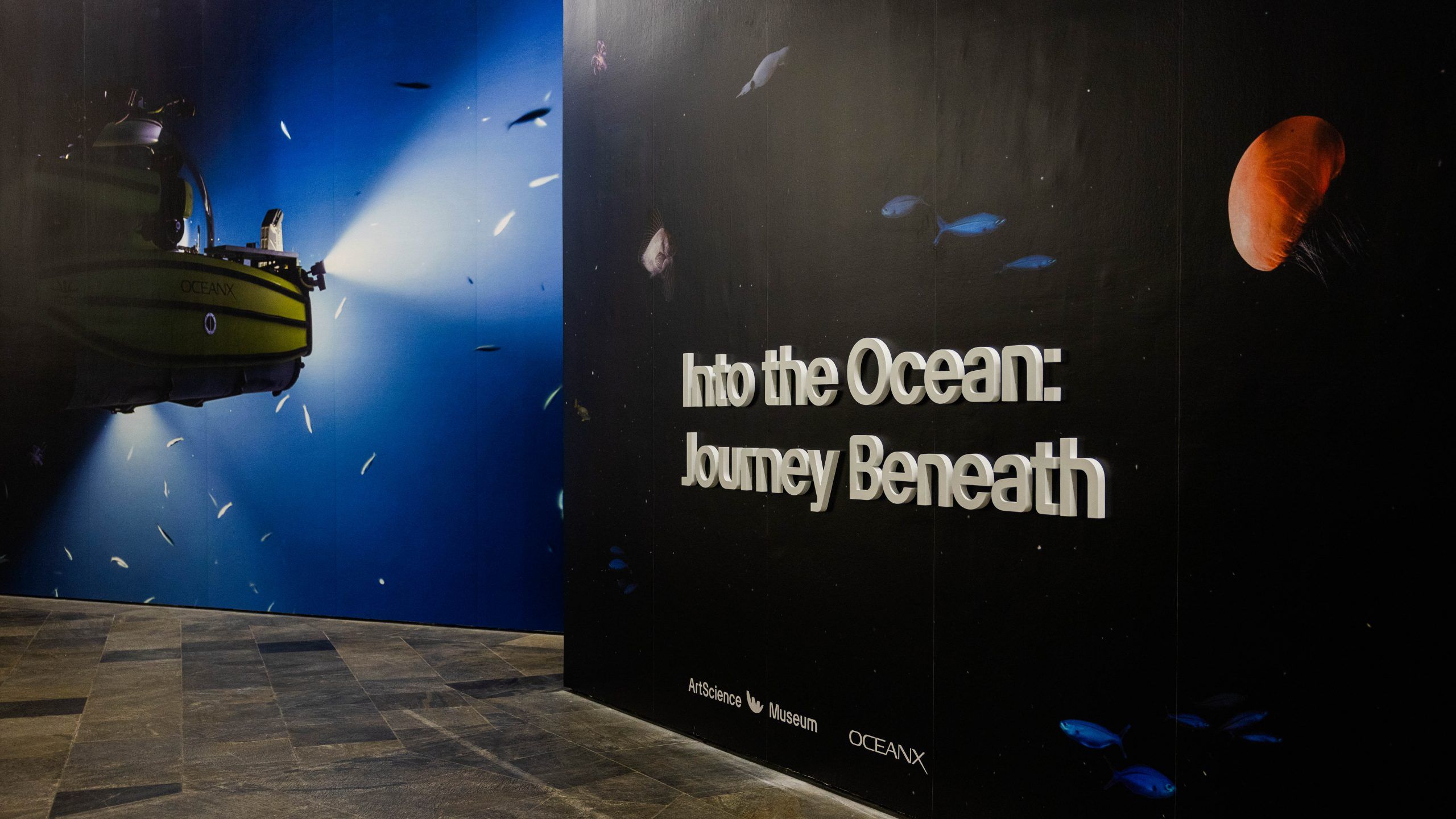
We at AUGUSTMAN believe in stewardship, and it is with that frame of mind that I visited Into the Ocean: Journey Beneath, a truly immersive, multi-media, multi-sensory exhibition at ArtScience Museum. The exhibition was developed and presented by ArtScience Museum in partnership with OceanX, a global non-profit ocean exploration initiative founded in 2016 that combines advanced marine research with high-end Hollywood-style media production to explore the deep sea and inspire global ocean conservation.
Spanning five meticulously structured zones—Descent, Photic Zone, Twilight Zone, Aphotic Zone, and Resurface—the exhibition guides visitors on a descending expedition from the sunlit surface to the deepest, darkest realms of the planet. Curated in close collaboration with OceanX scientists and researchers from Singapore’s world-class university research centers, the showcase manages to translate complex marine oceanography into a poignant, deeply felt human experience.
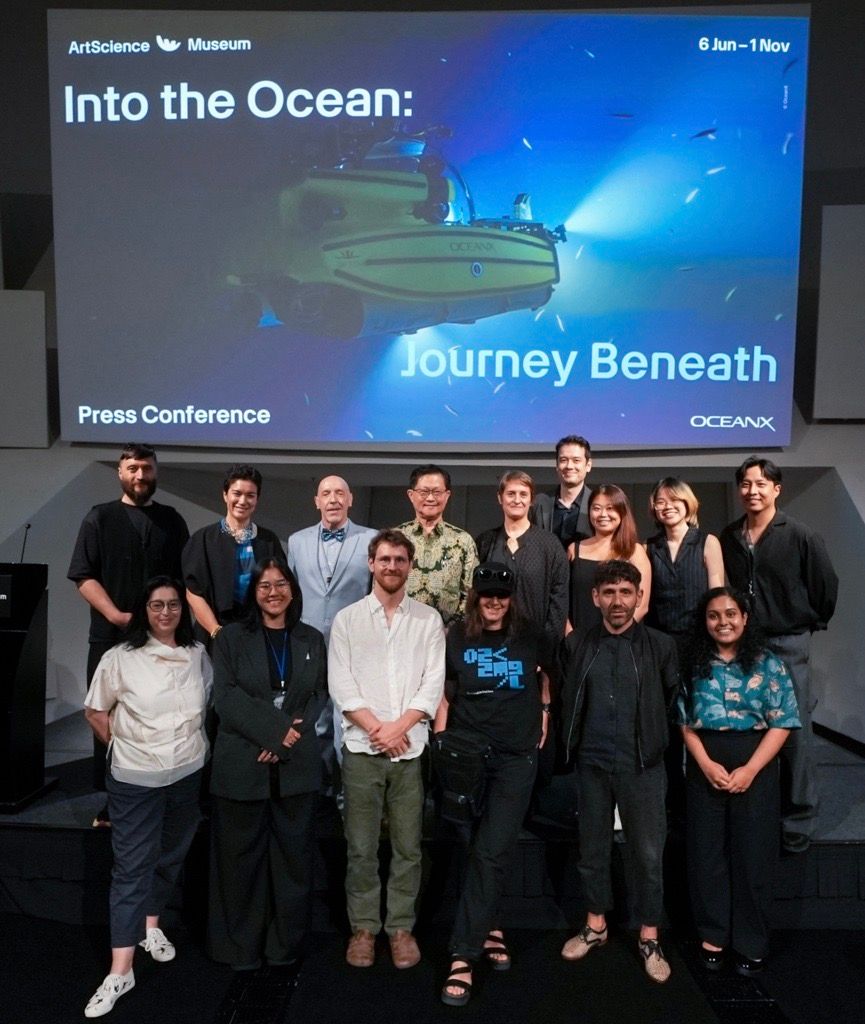
As Adrian George, Director of Programmes, Exhibitions and Museum Services at ArtScience Museum, explains, “The central mission was never to use art merely as a decorative wrapper for scientific facts. Instead, every single piece was created to grow organically out of the raw scientific data itself.”
This philosophy is echoed wholeheartedly by Kay Vasey, Director of Immersive & Digital Experiences at OceanX, who views technology and art as essential gateways to environments that would otherwise remain completely unseen. “One of the things I love about this work is that technology allows us to take people somewhere they’ll probably never go themselves,” Ms. Vasey shares. “At OceanX Education, we ask what technology can help someone understand or experience that would otherwise remain inaccessible. As Jacques Cousteau famously said, ‘People protect what they love.’ Technology isn’t the story – it’s the bridge that helps people connect with vast parts of our blue planet that most of us will never see first-hand.”
The core rationale behind this seamless integration of art and science stems from a fundamental accessibility barrier: the majority of visitors will never access these extreme depths themselves. “Art gives visitors the access—a way to feel a current, hear a whale, or sense a dying reef through sound, when they are unlikely to be able to see the reality,” says George. “Science gives visitors the proof—the specimens, the reef cores, the research partnerships behind every work. Neither could produce the intended outcome alone. Ultimately, that’s how we ensured the symbiosis works: we let the art carry the feeling and the science set the facts, so that every gallery can move a visitor from understanding a fact to being changed by it.”
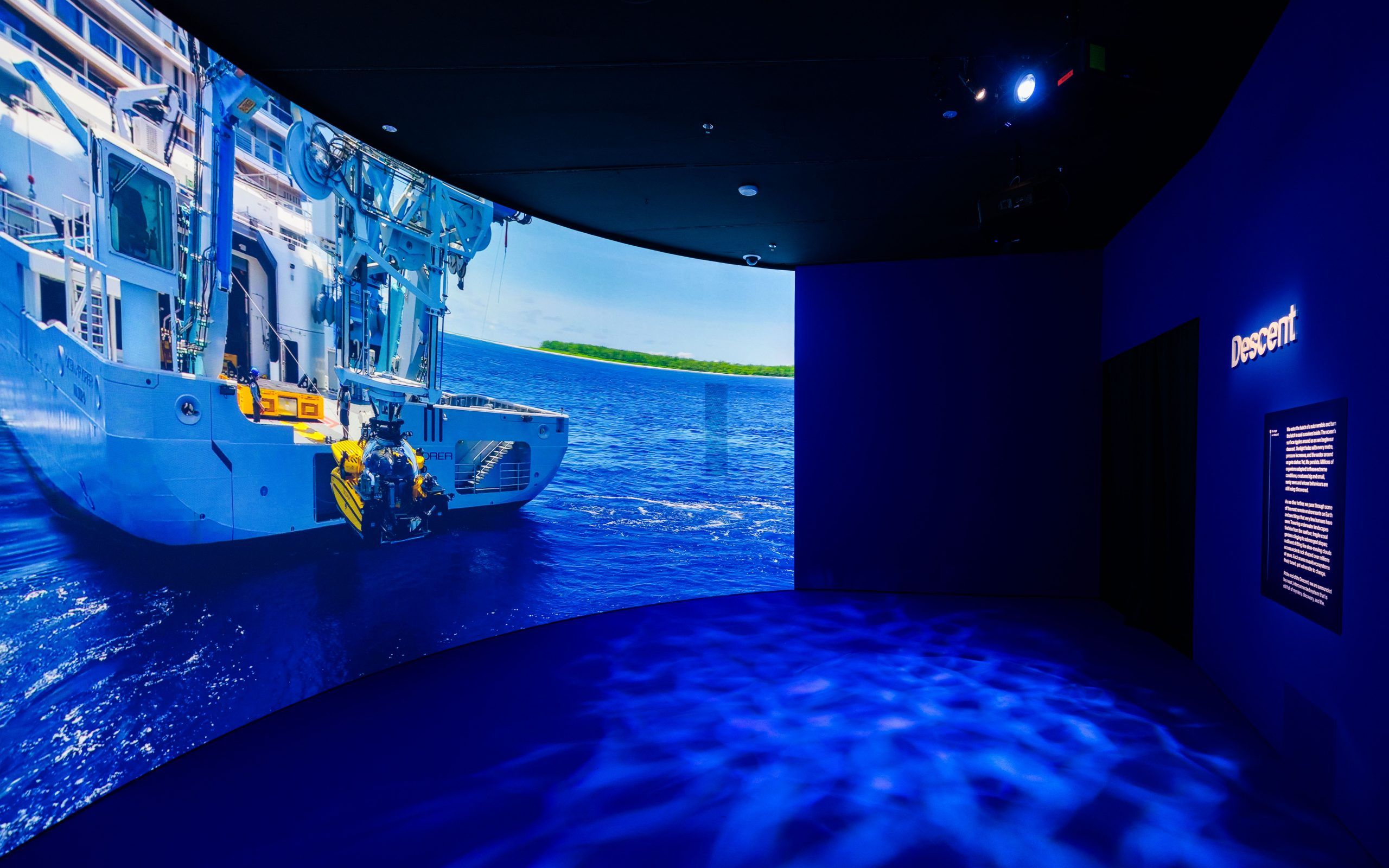
Descent: Stepping Aboard the R/V OceanXplorer
The experience begins with an expansive presentation of how OceanX carries out its work, and central to it all are two vessels called Nadir and Neptune. Together, they do all the things required to gauge the health of our oceans such as tagging sea creatures for study, as well as video and sound recording.
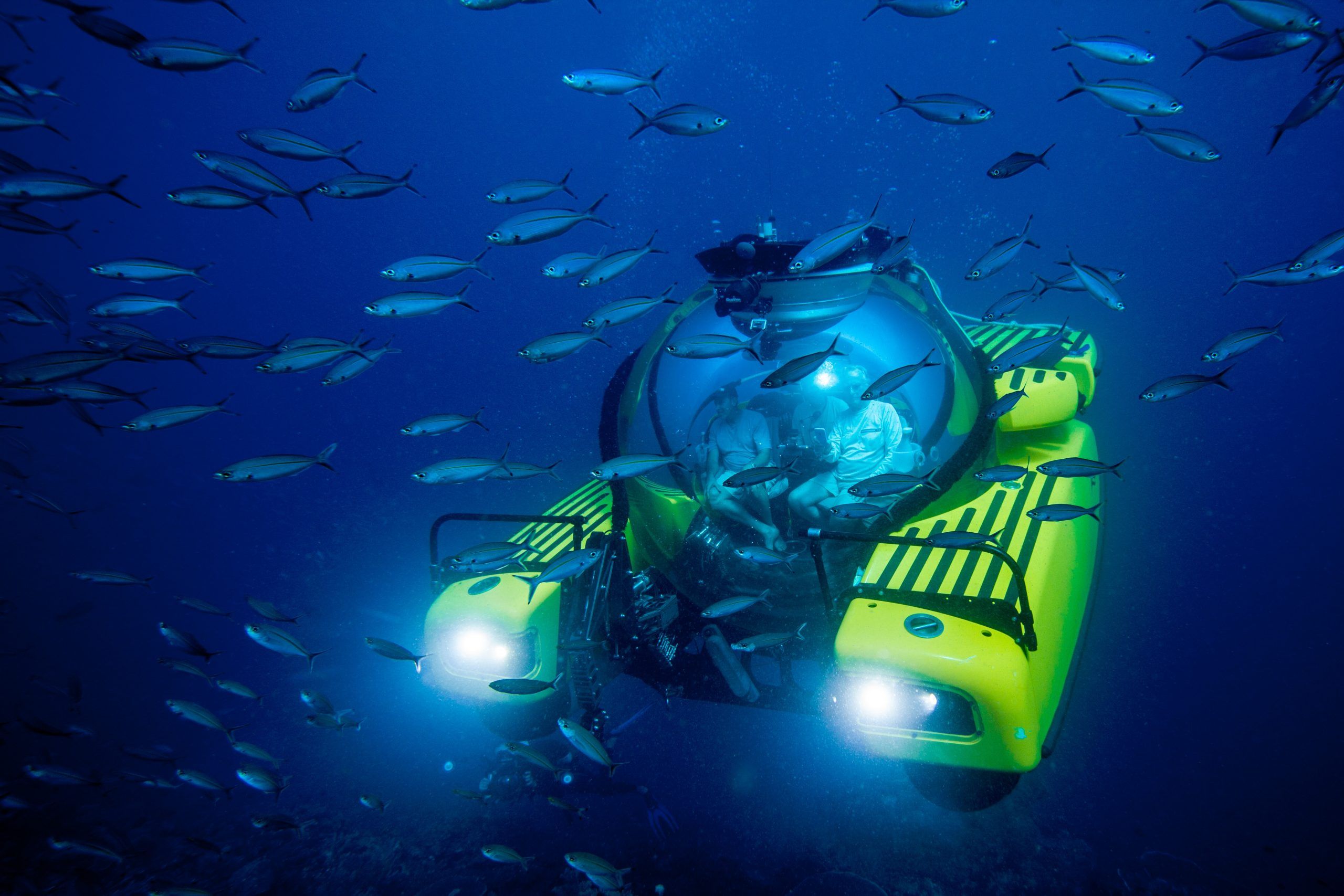
“Nadir and Neptune, our two piloted submersibles, can take scientists to depths of 1,000 metres. Our remotely operated vehicles – essentially, robotic explorers – can travel as deep as 6,000 metres, sending video and sensor data back to the ship while collecting carefully selected samples,” Vasey sahres. “At the same time, instruments measure the properties of the water, sonar maps habitats and environmental DNA reveals which species have passed through an area. OceanXplorer’s Mission Control then brings all of that information together enabling scientists to examine relationships and adjust their research in real time. The work involves engineers, vehicle pilots and scientific teams working together over many hours. It’s a real team effort, and that’s something people don’t always see.”
As Vasey details, collecting the raw oceanographic data required to build such an exhibition involves extraordinary teamwork and cutting-edge marine technology. “People often imagine ocean exploration as one incredible discovery. In reality, it’s thousands of pieces of information coming together to tell a much bigger story,” she explains. “Tagging is one important source of data. It can show where an animal travels and how its behaviour changes through the water column. OceanX expeditions build a much broader picture by bringing together information from many different tools.”
Photic Zone: Sunlit Depths and Senses Awoken
Emerging into the Photic Zone, which covers ocean realities down to 200 meters, visitors explore the sunlit upper layer where marine life is most abundant and interconnected. Here, screens display breathtaking OceanX footage of Red Sea corals (found in one of the warmest seas on Earth), showing how thriving reef systems persist even under extreme heat stress.

To ground this global narrative in local ecological history, the gallery showcases vertical reef core samples extracted from Cyrene Reef, Pulau Semakau, and Pulau Hantu by the Lee Kong Chian Natural History Museum at the National University of Singapore (NUS).
The immersive nature of the exhibition begins to show in earnest here as well.
Ms. Vasey shares, “Dive & Discover places them at the controls of a virtual OceanX submersible. In eDNA Detectives, they search water samples for genetic clues left behind by marine life… We also use cinematic footage, spatial sound, scent and interactive art. None of it is there just because it’s impressive. Each technology has an educational purpose. It makes something distant, complex or invisible easier to experience and understand in a multi-sensory environment.”
Multi-sensory artworks further expand the viewer’s capacity to perceive marine life across the space. Robertina Šebjanič’s Echinoidea Future – Adriatic Sensing combines glass-blown sculpture with AI-driven environmental data from the EU Copernicus platform so that “the sculptural form you’re looking at is literally shaped by the same data the scientists use,” according to Mr. George. Meanwhile, Sissel Tolaas’s Invisible Ocean reconstructs ocean “smellscapes” using eDNA and molecular ecology, Marco Barotti’s Coral Sonic Resilience utilizes 3D-printed structures to play recordings of thriving reefs, and bit.studio’s Flock of uses kinetic helium-filled balloons to mirror the fluid movements of a school of fish.
Twilight Zone: Navigating the Mesopelagic Shadow
Descending deeper between 200 and 1,000 meters, visitors enter the Twilight Zone, a realm of low light, cold temperatures, and intense pressure. One of the most fascinating presentations here is a video wall showing vertical diel migration—the largest animal migration on Earth—where millions of organisms ascend to surface waters at night to feed before returning to the shadows by day.
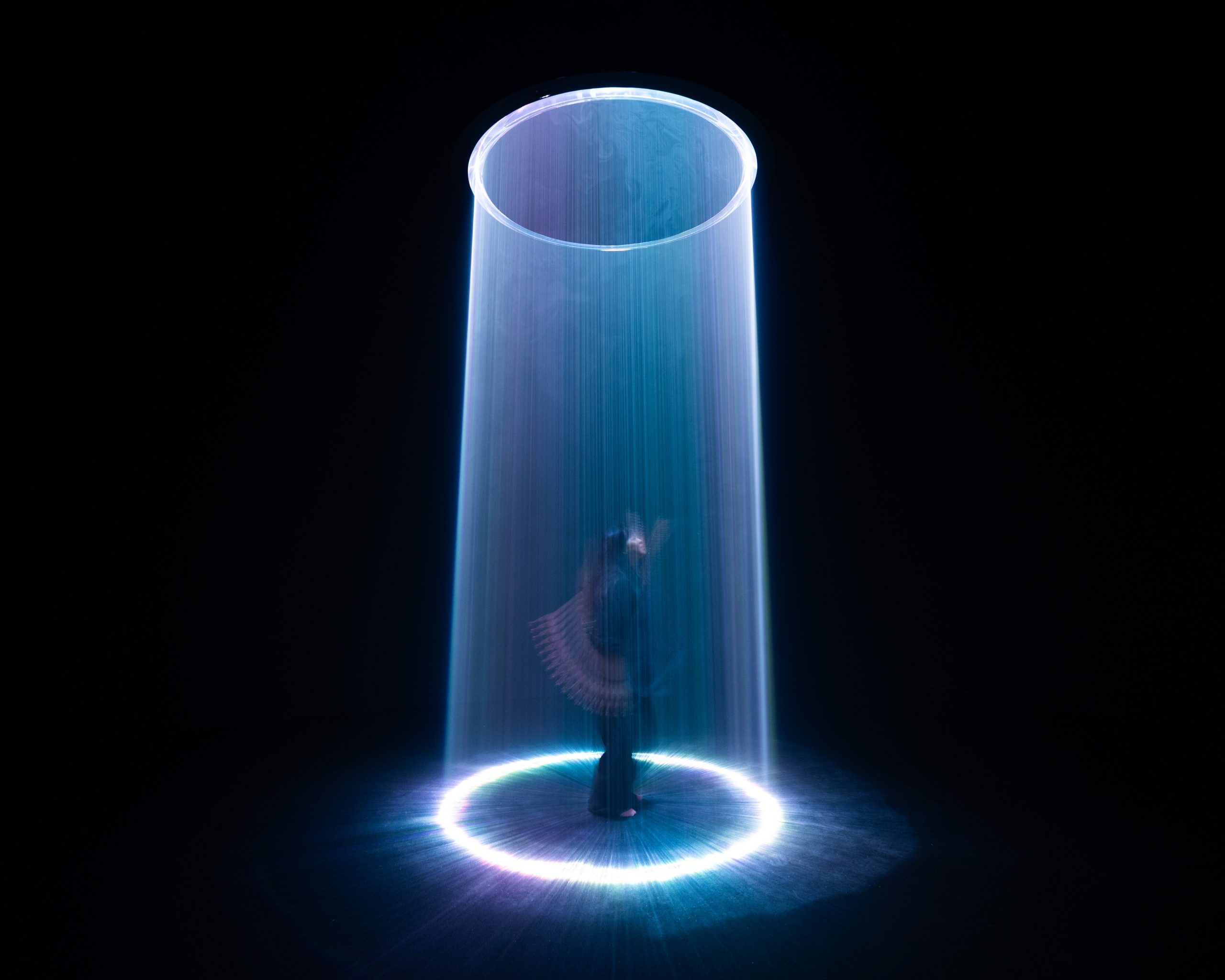
Alongside it, London-based artist collective Marshmallow Laser Feast presents Seeing Echoes in the Mind of the Whale, which uses hydrophone recordings and underwater videography to reconstruct how whales themselves perceive their surroundings through echo and vibration, while Lachlan Turczan’s Lucida translates wave physics into a light sculpture that responds in real time as you move through it.
Aphotic Zone: Listening to the Deep Ocean
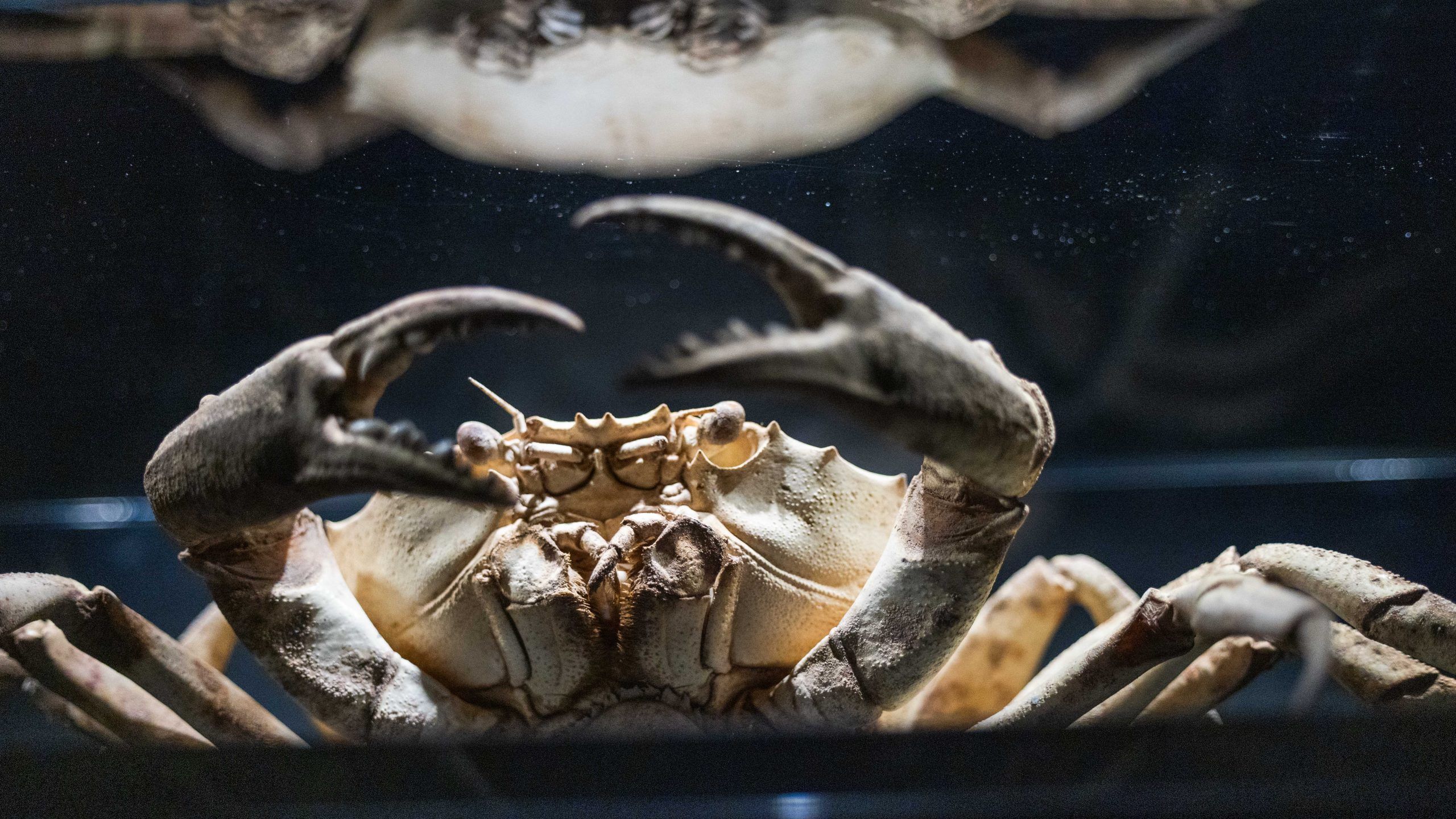
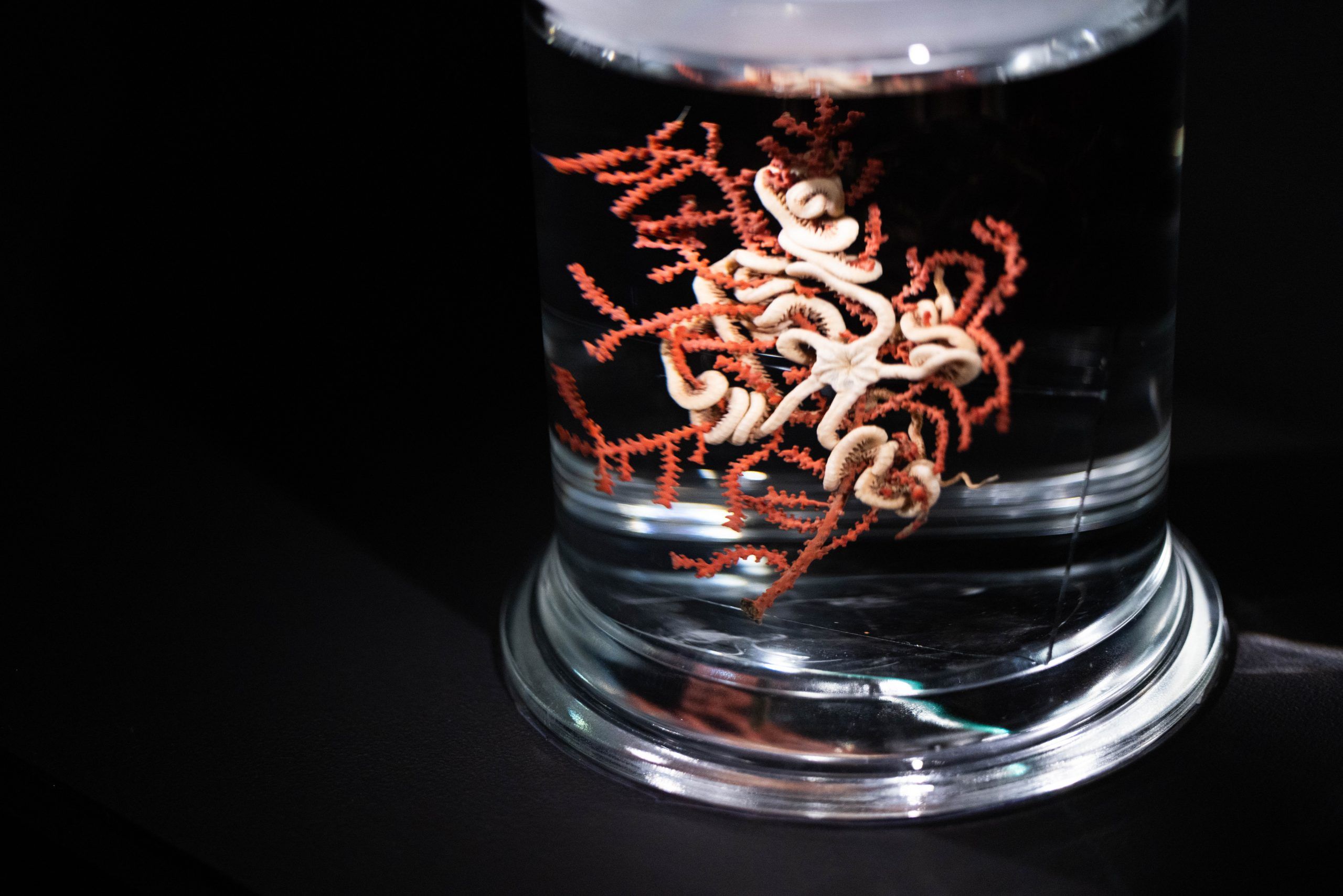
Plunging below 1,000 meters into the Aphotic Zone, visitors enter a world of permanent darkness and near-freezing 4°C temperatures. In this resource-scarce environment, life relies on chemical energy or sinking organic matter. Here, the museum exhibited real specimens of sea creatures that live in these extreme enviroments, such as the Japanese golden crab, batfish, and deep-sea shrimp. They are paired with OceanX footage of species like the vampire squid in their natural habitat.
But my favourite experience here has to be Brine Pools, a truly fascinating feature of the Aphotic Zone. Developed with filmmaker James Honeyborne using Blue Planet II footage, the experience recreates a hyper-saline, toxic underwater lake—specifically one nearly a kilometer beneath the surface of the Gulf of Mexico. “The sound and footage uncover the resilience of deep-sea ecosystems and let you sit inside an environment that is, by definition, permanently invisible to you otherwise,” notes George.
Vasey is keenly aware of the emotional reaction I had to Brine Pools. “Imagine descending through complete darkness for hours, only to discover what looks like a lake sitting on the ocean floor. That’s what makes brine pools so extraordinary,” Vasey says. “I absolutely loved recreating this piece with the award-winning British wildlife filmmaker James Honeyborne. He was there when that footage was first captured, so working with him to recreate what it felt like to be at the forefront of such an extraordinary discovery was genuinely spine-tingling.”
To frame the broader philosophical significance of such moments, Ms. Vasey invokes one of her heroes. “Sylvia Earle has often said, ‘With every drop of water you drink, every breath you take, you’re connected to the sea.’ Experiences like this remind us just how much of that connected world remains unexplored. That is the approach we take across OceanX Education. We begin with authentic exploration, then use immersive storytelling to help people understand what was discovered and why it deserves attention.”
Resurface: From Understanding to Direct Action
Ascending from the deep sea, visitors re-emerge into the light of Resurface, a section that brings visitors back to shallow surface waters where seagrass meadows function as critical nurseries for marine life. In this concluding gallery, art and science turn into direct action.
Ms. Vasey details the intentional narrative arc designed to empower visitors upon departure. “One of the things we thought about a lot was how we wanted visitors to feel when they left. After taking them into some of the most remote and mysterious parts of the ocean, it was important to bring them back with a genuine sense of hope and possibility,” Ms. Vasey shares. “Resurface was designed to bring visitors back from the deep ocean with a sense of agency. After encountering environments that may feel vast and remote, we wanted to end with an ecosystem that is close to our coastlines and open to restoration. Seagrass meadows provide nursery habitats for marine life, protect coastlines and store carbon within their sediments. They’re often overlooked because so much of their value exists beneath the surface, yet they’re one of the ocean’s quiet heroes.”
Within the gallery, the interactive experience Seagrass Stories: Help the Ocean to Heal bridges regional scientific research with public engagement. “Seagrass Stories was led by Nada Abdelkader, a Tunisia based marine ecologist and OceanX Education Resident. Her restoration work draws inspiration from traditional fishing traps used by Tunisian fishermen,” Ms. Vasey explains. “Through the residency, she worked with our immersive media team and creative partners to translate that knowledge into an interactive experience. Visitors use simple gestures to initiate the planting of seagrass. As more people participate, the meadow becomes healthier and more resilient. It’s a lovely reminder that even small actions can become something much bigger when people work together. The experience is also connected to regional restoration efforts through WWF Singapore.”
“Resurface reflects what we want OceanX Education to achieve,” Ms. Vasey adds. “We want visitors to leave not just with a greater understanding of these remarkable ecosystems, but with a real sense of wonder, optimism and the belief that positive change is possible when we all play our part. If people walk away feeling more connected to the ocean – and more inspired to protect it – then we’ve achieved what we set out to do.”
Crucially, the actions of visitors support the development of an actual NUS-led seagrass nursery prototype, developed by the Tropical Marine Science Institute as part of a World Wide Fund for Nature (WWF) initiative protecting up to 100,000 hectares of seagrass across Indonesia, the Philippines, Malaysia, and Thailand.
Addressing the larger question of how environmental education must evolve to drive tangible change in modern society, Ms. Vasey offers an incisive diagnostic on the gap between information and action. “I actually think we’ve reached the point where information alone isn’t enough,” she argues. “We’ve never had more documentaries, headlines or scientific research about the ocean than we do today – and that’s a really positive thing. The challenge now is helping people turn that awareness into action. There is a gap. Information is abundant; meaningful participation remains much harder to find. A great deal of environmental communication stops at awareness. People learn what is going wrong and may understand the scale of the problem, then leave without a clear sense of how the ocean shapes their lives or where they can contribute.”
To counter doom-laden narratives, Ms. Vasey advocates for a grounded, evidence-based optimism. “One of the things I really admire about Hannah Ritchie’s book, Not the End of the World, is her reminder to follow the data, not just the ‘doomsayer’ headlines,” Ms. Vasey emphasizes. “She makes the case that optimism isn’t about ignoring the challenges – it’s about recognising the evidence that progress is possible when science, innovation and communities work together. I think that’s an incredibly important message, particularly for younger generations who can sometimes feel overwhelmed by the scale of the challenge. Ocean literacy needs to progress from experience to understanding, then from agency to action. Effective education makes complex systems visible and connects them to human wellbeing. It should also give people a credible next step. Education alone won’t reverse climate change or pollution. But it creates informed citizens, inspires future scientists and gives communities the confidence to support meaningful change. For me, success isn’t measured by how much information someone remembers when they leave. It’s whether they leave feeling connected to the ocean – and believing they have a role to play in its future.”

When addressing the reality of eco-anxiety that affects so many today, Ms. Vasey reframes our collective relationship with environmental conservation. “I’m actually optimistic – but it’s an optimism grounded in science, not wishful thinking,” she reflects. “I would frame our role a little differently. OceanX is one part of a large global effort to build a future in which humanity and the ocean can thrive together. I feel a real sense of urgency, alongside confidence in what informed, sustained action can achieve. We have seen ecosystems recover when they receive the right protection. New technologies are helping scientists understand places and species that were previously beyond our reach. Better knowledge is giving communities and decision-makers a stronger foundation for action. Progress doesn’t always make the headlines, but it is happening – and that’s something we shouldn’t lose sight of.”
“Eco anxiety is understandable because the challenges are real and the scale can feel overwhelming,” Ms. Vasey concludes. “People must understand that whilst we are part of the problem, we are also part of the solution, and the solutions needed to protect our blue planet have always been bigger than any one person. Our role in OceanX Education is to help people understand the ocean’s connection to their own lives, see where progress is already happening, and find meaningful ways to participate. If people leave Into the Ocean: Journey Beneath feeling more curious than fearful, more connected than overwhelmed, and believing they can be part of that collective effort, then that’s where I find hope.”
Summing up the standard to which the entire showcase was held, Mr. George concurs: “Ocean science is incredibly complex, we didn’t want to dilute that nor did we want to make the exhibition demanding or challenging to understand. So our approach was to layer the experience, so that people of all backgrounds could find an entry point that resonates with them… Our goal throughout was to make the experience accessible and intellectually rewarding at the same time, without ever losing the nuance that makes ocean science so compelling. That’s the standard every artist was selected against: could their practice evoke emotions, meaning and at the same time communicate complex ideas with someone who knows nothing about the ocean, while still offering meaning for someone… who knows a great deal about our ocean.”
 SUFFIAN HAKIM
Leave a comment